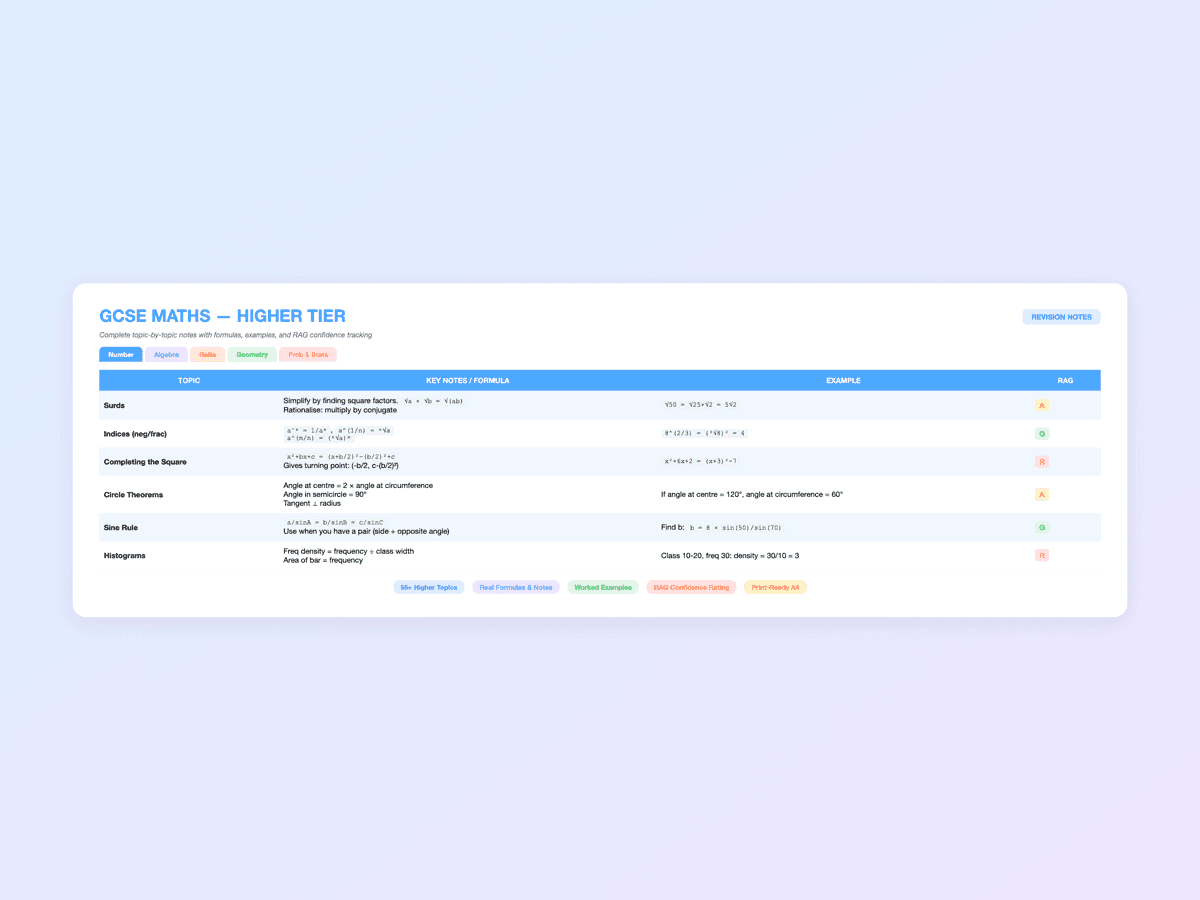
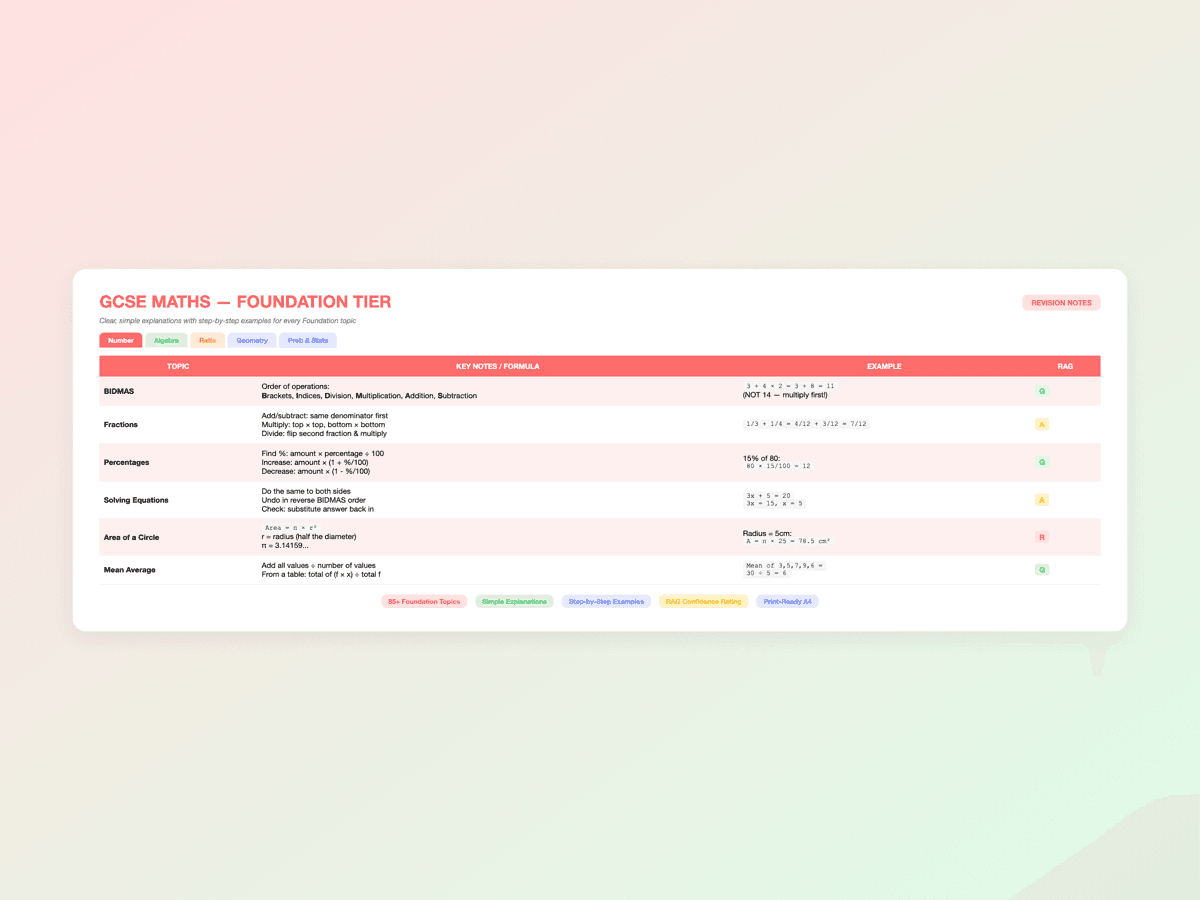
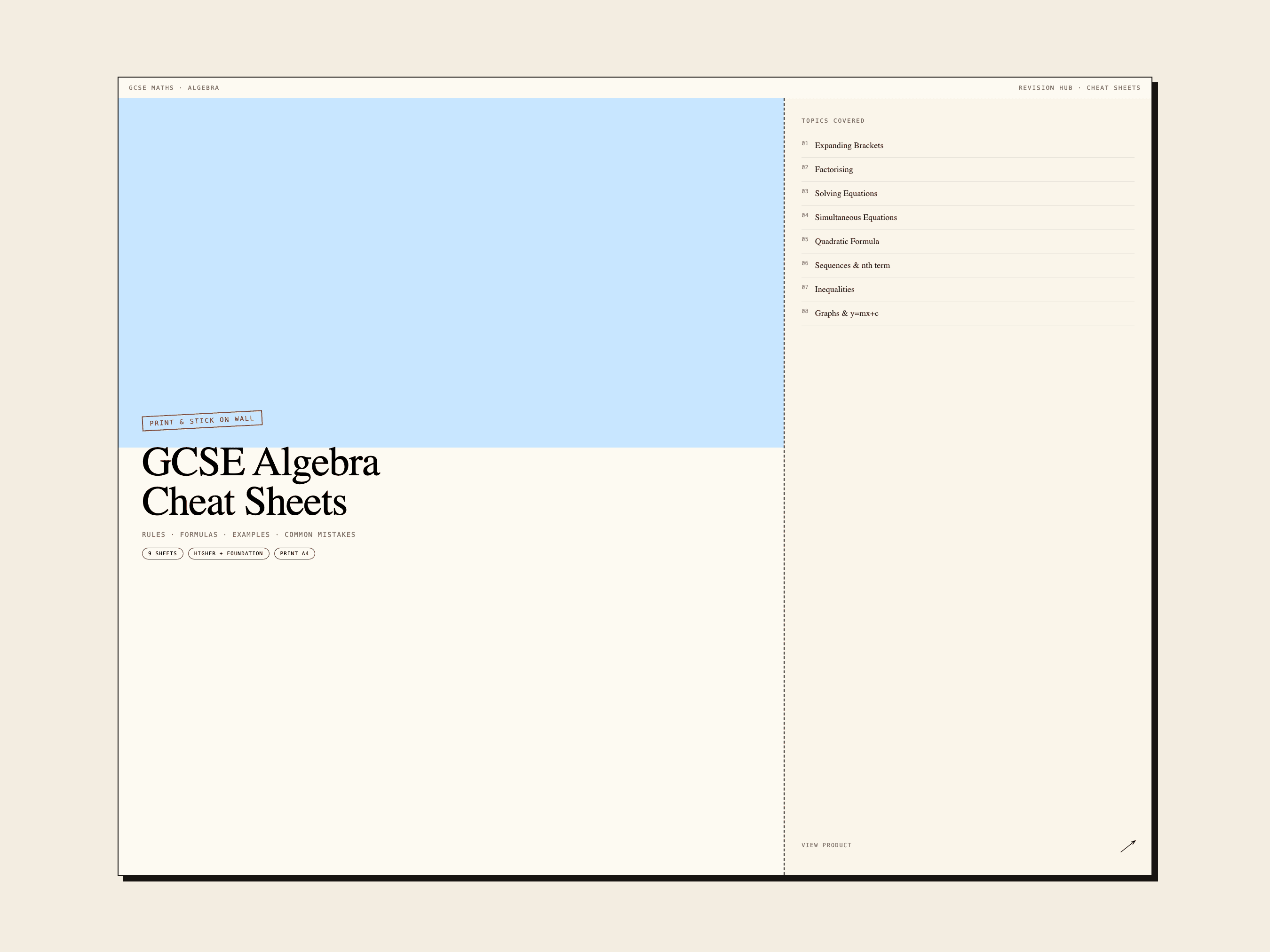
Complete revision notes for Higher and Foundation tier. Every formula, every topic, every worked example you need.
Most GCSE Maths revision notes are either too brief to be useful or so long you never finish reading them. Ours are different — every topic is one row with the key formula, a clear explanation, and a worked example. No waffle.
55+ topics including surds, circle theorems, sine/cosine rule, completing the square, vectors, histograms, and algebraic fractions.
85+ topics with simpler explanations. BIDMAS, fractions, percentages, basic algebra, shape, area, averages — all explained clearly.
Both versions include a RAG confidence rating (Red/Amber/Green) so you can track which topics need more work. Rate each topic as you revise, then focus your time on the red ones.
GCSE Maths covers 5 main areas: Number (fractions, percentages, indices, surds), Algebra (equations, graphs, sequences, quadratics), Ratio & Proportion (ratios, percentages, compound measures), Geometry (shapes, angles, trigonometry, vectors, circle theorems), and Probability & Statistics (averages, charts, probability, histograms).
Foundation tier covers grades 1-5, Higher covers grades 4-9. Higher includes harder topics like surds, circle theorems, sine/cosine rule, quadratic inequalities, iteration, and algebraic fractions. Our notes come in separate Higher and Foundation versions so you only revise what's relevant.
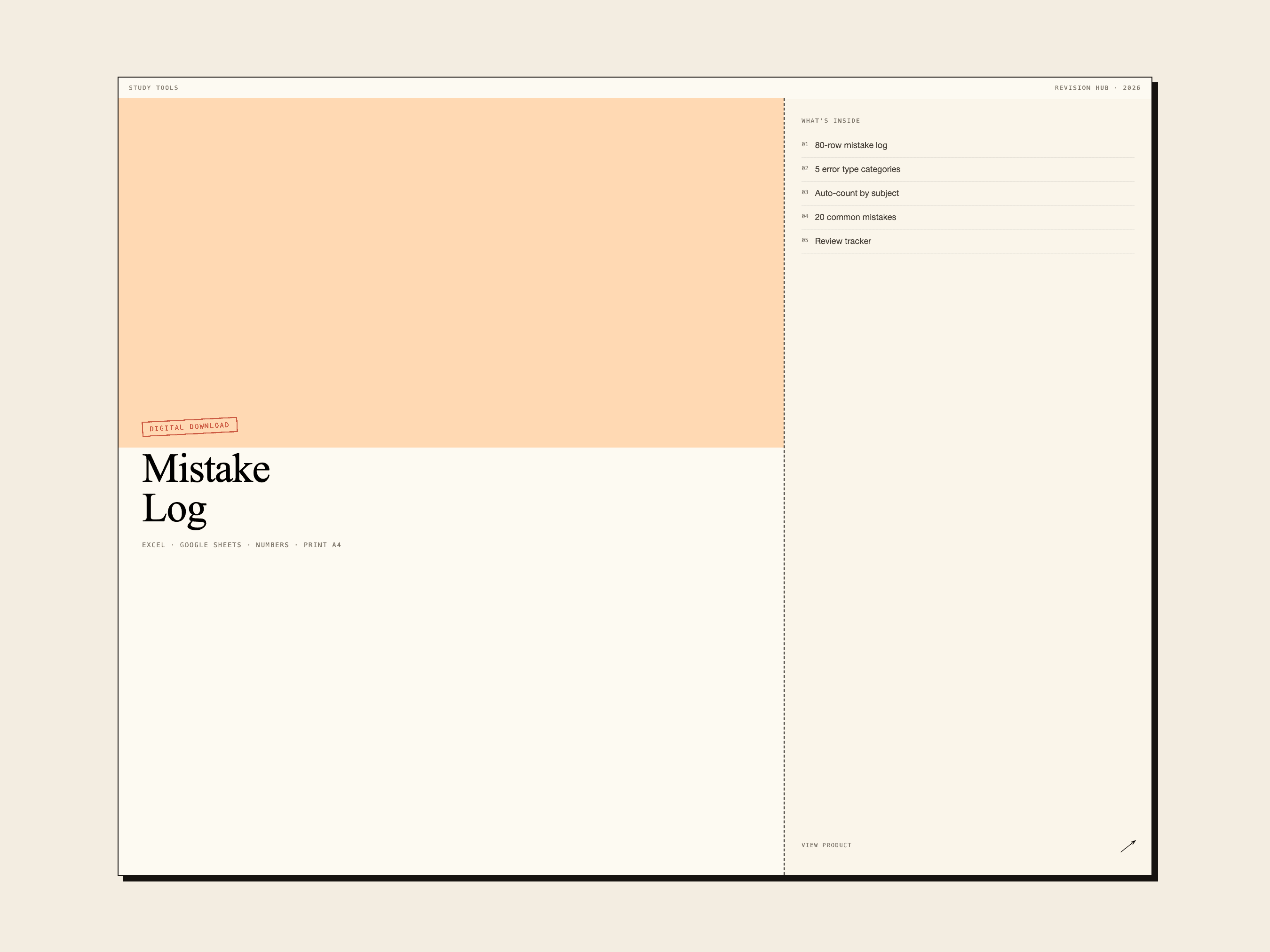
Start by identifying your weak topics using our RAG (Red/Amber/Green) rating system. Focus on Red topics first. Practice past papers under timed conditions. Use our Mistake Log to track errors and learn from them. Don't just read notes — actively solve problems.
You're given a formula sheet in the exam, but you should memorise: quadratic formula, Pythagoras, trig ratios (SOHCAHTOA), area of a circle, circumference, speed/distance/time, density, and compound interest. Our notes include all key formulas clearly laid out.
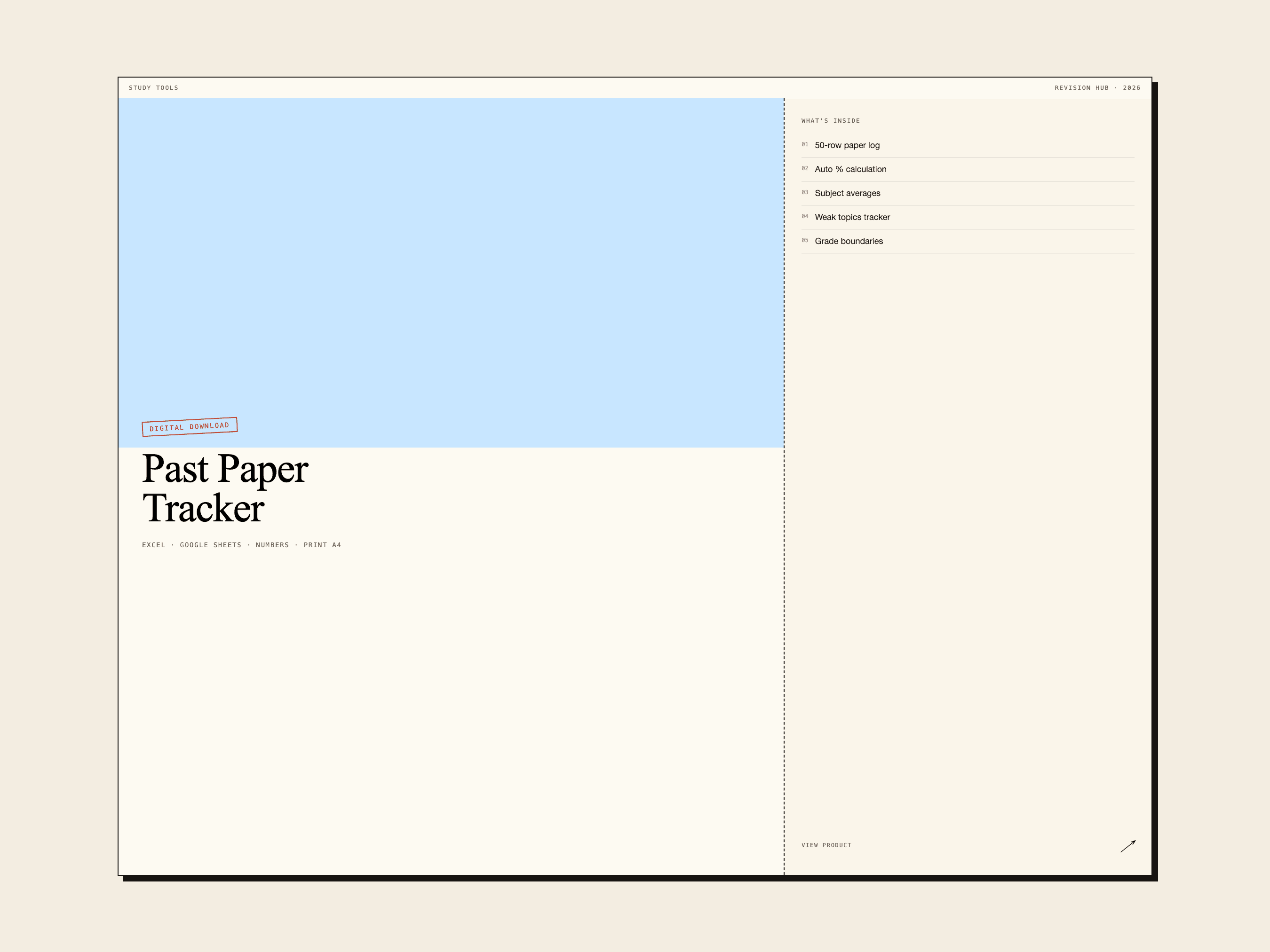
Aim for at least 5-10 full papers. Do 2-3 from your specific exam board (AQA, Edexcel, OCR) and the rest from other boards for variety. Mark them yourself using mark schemes, then use our Past Paper Tracker to spot trends in your scores.